
 1889
1889
Born 11th August
1901
Census National Archives records him as the 11 year old son of George E Roberts & Elizabeth A Roberts
Address: 291 Seven Sisters Road, Stoke Newington, London
1914
August
Edgar George Roberts joined the Honourable Artillery Company and was a Driver in its B Battery. He went with this unit to Egypt on 9 April 1915.
1915
July
B Battery fought in the recapture of Sheikh Othman.
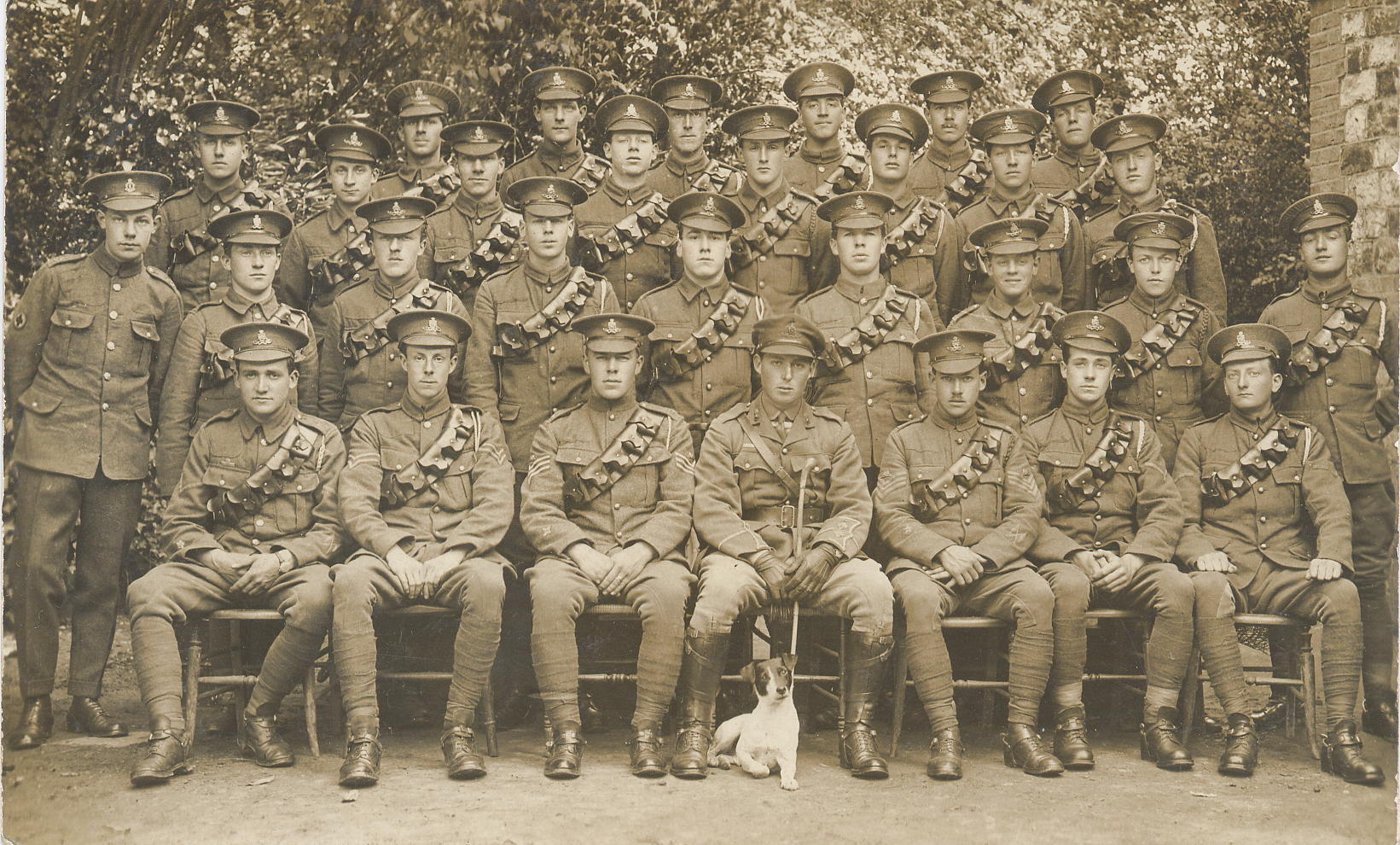
The HAC’s B Battery’s mascot, ‘Teddy’, poses with Newlyn Mason Elliott, its commander, and other members of B Battery, c. 1917.
1916
18th August
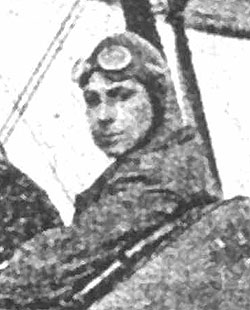
Driver Edgar George Roberts, from the Honourable Artillery Company, Territorial Force, was appointed to be a temporary Second Lieutenant for duty with the Royal Flying Corps (R.F.C.)
2 November
Passed his Flying Certificate at the Military School, Ruislip. Early flying career involved training on Maurice Farman biplanes, before moving on to BE2c’s.
1918
13 September
Posted to No. 205 Squadron of the Royal Air Force.
Whilst with No. 205 Squadron Edgar flew DH9’s engaged upon bombing missions against the German Army during the Hundred Days Campaign.
Subsequently he was attached to the Intelligence Corps at HQ22 wing, which included temporary duty with No.211 Squadron, which also flew DH9’s.
Here he was deployed upon photographic reconnaissance and bombing operations against the German Army, which by this stage of the Great War was heavily engaged in a desperate fighting retreat prior to the Armistice on 11 November 1918.
1919
18 April
Roberts was serving with No.9 Squadron on RE8’s (nicknamed ‘Harry Tates’), which had a brief reconnaissance role with the British Army of Occupation (BAOR) in Germany.
7 June
Demobilized and placed on the ‘Unemployed List’.
His index card held by the Honourable Artillery Company states he was commissioned into the RFC on 18 August 1916 and went to France around February 1917, staying there until June 1917. He then seems to have returned to England in June 1917 until Sept 1918, returning overseas Sept 1918 until June 1919. The card also states he was a Lieut (pilot) in the RAF and was attached to the Intelligence Corps. He is also noted as being Staff Officer, 4th Class, Grade 2. The card also states ‘”crashed” France 1917’.
This card appears to have been filled in by EGR himself and posted back to the HAC in 1919.
Timeline
1918 - Click to open
1918
1 Apr 1918
The Royal Air Force and Women’s Royal Air Force are formed.
 21 Apr 1918
Baron Manfred von Richthofen, otherwise known as “The Red Baron” is shot down and killed near Corbie.
August 1918
The RAF introduces offensive fighter sweeps on the Western Front.
8 Aug 1918
The Allies launch a major offensive on the Western Front.
21 Sep 1918
RAF aircraft in Palestine attack and destroy the retreating Turkish Seventh Army at Wadi el Fara.
14 Oct 1918
The largest bomb of the war, 1650lbs, is dropped by a Handley Page 0/400 aircraft of the Independent Air Force.
4 – 10 Nov 1918
The last intense combat of WWI. The RAF claim 68 enemy aircraft for 60 losses.
11 Nov 1918
At 10:45 on the morning of November 11th, the crew of a 15 Sqn RE.8 observation aircraft landed at Auchy and reported no enemy
aircraft or anti-aircraft fire seen. Fifteen minutes later, Armistice with Germany was declared and the war ended.
1919 - Click to open
1919
11 Jan 1919
Winston Churchill is appointed Secretary of State for War and Air and Major-General Sir Hugh Trenchard becomes Chief of the Air
Staff.
14/15 Jun 1919
Captain John Alcock and Lt Arthur Whitten Brown make the first non-stop crossing of the Atlantic by aircraft. The Vickers Vimy bomber flew from St John’s, Newfoundland to Clifton, County Galway, Ireland in 16 hours 27 minutes.
2-6 Jul 1919
The British airship R34 makes the first airship crossing of the Atlantic, flying from East Fortune, Scotland to New York.
 18 Jul 1919
The RAF’s top ranking ace of World War I, Major Edward “Mick” Mannock is posthumously awarded the Victoria Cross.
4 Aug 1919
Inter-service squabbling in the wake of massive post-war defence cuts reaches a new low when the Army and Navy refuse to allow the RAF to use their officer ranks, forcing Trenchard to create new ones. The new rank titles (Pilot Officer, Flight Lieutenant etc.) came into being on this date.
23 Oct 1919
Royal Air Force Benevolent Fund founded by Lord Trenchard.
1920 - Click to open
1920
Jan – Feb 1920
The RAF’s first “little war”. RAF units were involved in operations with the Camel Corps in British Somaliland (now Somalia) to overthrow Dervish leader Mohammed bin Abdullah Hassan, the “Mad Mullah”. The airborne intervention was “the main instrument and decisive factor” in the success of the operation. Ten dH9s were dispatched to form “Z Force”, and were used for bombing, strafing and as air ambulances.
5 Feb 1920
The RAF College opened at Cranwell, Lincolnshire.
1 Apr 1920
The WRAF was disbanded.
3 Jul 1920
Over 60,000 spectators attend the first RAF Pageant at Hendon, London.
1921 - Click to open
1921
The RAF’s new role of policing the Empire greatly helped to maintain it’s status as an independent fighting force. The defence cuts after the Great War saw the RAF fighting for its survival as the Royal Navy and Army sought to take control of the RAF’s assets.
23 Jun 1921
Nos. 30 and 47 Sqn, RAF, begin the RAF’s weekly Cairo – Baghdad mail service.
1 Aug 1921
The RAF takes delivery of the first purpose-built troop-carrying aircraft, the Vickers Vernon, a development of Vimy bomber with a
bulbous fuselage.
1 Oct 1921
The RAF assumes military control of Mesopotamia (now Iraq) and Jordan.
1922 - Click to open
1922
1 Squadron Snipe Aircraft 9 Feb 1922- The Royal Air Force Reserve is created.
4 Apr 1922
RAF Staff College opened at Andover; It’s first Commandant is Air Commodore H R M Brooke-Popham.
1923- Click to open
1923
Jun 1923
The RAF Nursing Service was renamed Princess Mary’s Royal Air Force Nursing Service.
20 Jun 1923
Acting on the recommendations of the Committee of National and Imperial Defence, the Prime Minister advocates a home
defence force of 52 squadrons.